

Couple create buzz about bees at fair’s honey exhibit
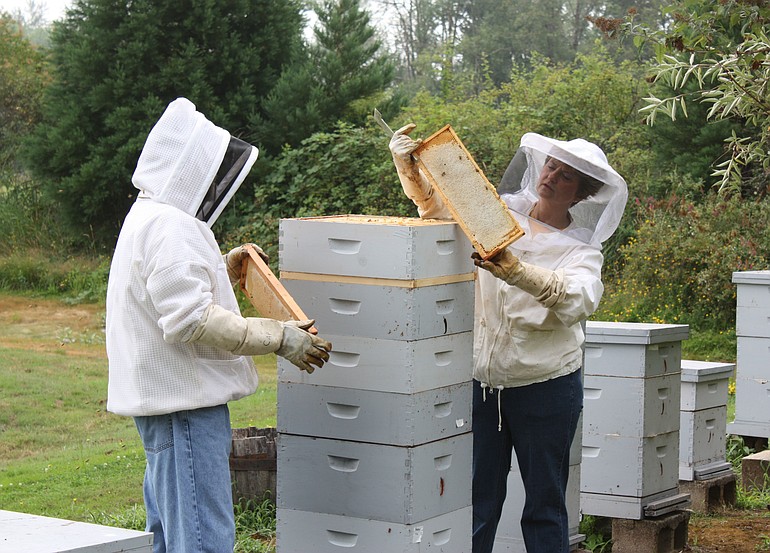
Chuck and Judy Pepper check one of their bee colonies. The Peppers, but not the bees, are at the fair this week.
Monday, August 9, 2010
Video
The Buzz of the Fair
Chuck and Judy Pepper talk about their hobby beekeeping operation and the Clark County Fair.
If you go
• What: Clark County Fair.
• Hours today: 10 a.m. to 10 p.m.
• Where: 17402 N.E. Delfel Road, Ridgefield.
• Admission: Adults, $10; seniors 62 and older, $8; kids 7-12, $5 from 10 a.m.-5 p.m. today, $7 after 5 p.m.; kids 6 and younger, free; parking, $6; C-Tran shuttle, $2 per person round trip from area park-and-ride lots.
• Carnival: Noon to 10 p.m., unlimited rides, $25.
• Sleep Country Amphitheater: Boys Like Girls, 8 p.m., $20-$35, includes fair admission, sold at Ticketmaster.com. Grandstands: Northwest Pro Rodeo, 2 p.m. Pro Barrel Racing; 6:30 p.m. Pro Rough Stock Rodeo, including Bucking Broncs, free with fair admission.
• Other highlights: Valentine’s Performing Pigs, 1, 3 and 5 p.m.; Hypnotist Jerry Harris, 7 and 9 p.m.
• Pets: Not permitted, except for personal service animals or those on exhibition or in competition.
• Information: www.clarkcofair.com or call 360-397-6180.
For a couple of upstate New York transplants who have made their home in north Clark County for 35 years, Chuck and Judy Pepper found more than a hobby, they found 500,000 “friends.”
The Peppers’ social circle is rich with the sweet taste of honey thanks to the buzzy-bodies, which occupy nine hives in the couple’s Battle Ground backyard and will produce about 300 pounds of honey this year.
As hobby beekeepers and members of the Clark County Beekeepers Association, the group that sponsors the Clark County Fair’s bee barn, the Peppers found a passion for the tiny insects with a diverse and vital role in nature.
Chuck’s father was an East Coast beekeeper but Chuck never showed an interest. After his father died, Chuck decided to take a beekeeping class that Judy tagged along for and before they knew it, the couple is in their sixth year of their beekeeping hobby and loving it.
“More than anything, it’s just fun,” Chuck said while talking about the community aspect of working with bees and other beekeepers.
Now as co-superintendents of the fair’s beekeeping and honey exhibition, the Peppers are able to share their passion for bees, along with the rest of the beekeepers association, and for the 18th year, the national honeybee queen.
This year’s honeybee queen, Lisa Schluttenhofer, a Purdue University student, travels the country spreading her message that honeybees provide the building blocks for the food supply. She said one-third of everything Americans eat depends on honeybees.
“Bees are truly fascinating insects,” Schluttenhofer said. “One bee in its lifetime will make one-twelfth of a teaspoon of honey.”
Schluttenhofer has traveled to states from Florida to Iowa, but this is her first time in Washington. As a hobby beekeeper since the age of 12, Schluttenhofer spends time in the fair’s bee barn teaching and sharing with visitors and she also acts as a celebrity judge for fair competitions.
Her work includes judging honey by looking at the color, clarity and thickness of this year’s entries, plus the most important factor: taste.
Local honey
With the cool weather to start the summer, local beekeepers like the Peppers weren’t sure what kind of honey crop they would find come harvest at the end of July and beginning of August.
But luckily the fields dried in time for the Pepper’s bees to take advantage of blackberry blooms in June, the primary source of nectar for the Pepper’s bees. It will make for a decent honey harvest.
Each April the Peppers start with packages of 15,000 bees that they put in hive boxes. The hope is that the number increases to 50,000 to 60,000 bees per hive by summer harvest.
At harvest, the Peppers transport the honey-filled hives into their bee barn, where they remove the forms, cut off the wax, and send the forms through an extraction process that spins the honey out of the comb and into a pail.
From that point, the honey is strained and bottled and ready for a morning piece of toast or to sweeten a cup of tea — two of the many uses the Peppers find for the honey they produce.
The Peppers noticed this year’s honey to be slightly lighter than previous years. They said this might be caused by the wet season, but it’s hard to be certain.
Jordan Frasier: jordan.frasier@columbian.com
Rate this
You must be logged in to rate this.
Current Rating : Nobody has rated this article yet.
Search Alerts
Receive updates from us on people or topics that interest you. (What's this?)
Sign up to receive email and/or text alerts from us whenever someone or something of interest appears on columbian.com. For example, if you follow the Blazers, you could enter LaMarcus Aldridge and we'd send you a link to our stories whenever he is mentioned in them. You just enter the person's name or other search terms, i.e., light rail or Vancouver crime, and then click Submit to sign up to receive updates. Note: Keep in mind that carrier charges may apply for SMS updates.
Choose a term below or enter in your own for you to automatically receive alerts when we post something new.


