


Sunday, November 30 | 8:28 p.m.
BY JOHN BRANTON
COLUMBIAN STAFF WRITER
Vancouver tornado in 1972
Steve Pierce A map made by weather specialist Steve Pierce of Vancouver shows the damage path, in red, of the Jan. 10, 2008, tornado that crossed† Vancouver Lake and headed east along Sluman Road and 78th Street to Northeast St. Johns Road, and beyond to the Hockinson area.
FIVE PEOPLE DIED WHEN HIT BY DEBRIS AND A FALLING WALL AT THE OLD WAREMART GROCERY ON FOURTH PLAIN BOULEVARD IN A TORNADO THAT STRUCK EAST VANCOUVER ON APRIL 5, 1972. ANOTHER WOMAN DIED ABOUT A HALF-MILE AWAY. Photo by Walt Hicks Apr 5 1972
Steven Lane/The Columbian files Becky Bittner of the Vancouver Lake Crew tries to recover some items after the Jan. 10 tornado destroyed the club’s boats and rowing headquarters.
In January, after a tornado spun and danced its way across Vancouver Lake and ripped into Hazel Dell, someone spray-painted “tornado alley” on a piece of plywood along its path.
It wasn’t a complete exaggeration, according to a group of scientists, trained specialists and weather buffs who met in November to discuss the Jan. 10 twister, which caused more than $500,000 in property damage but hurt no one.
Tornados are rare in this area, and will continue to be, scientists said in a meeting of the Oregon chapter of the American Meteorological Society in Portland.
But the few tornados that have hit here have similarities, said Dave Elson, lead forecaster with the National Weather Service in Portland, who worked seven years in tornado-prone Indiana.
“They begin as common showers and thunderstorms over the north Oregon Coast Range, then intensify quickly as they pass over the Tualatin Mountains and move east across the Columbia River.
“There, the storms encounter winds that are more favorable for tornado development, south winds channeled by the Willamette and lower Columbia River valleys.”
Such south winds blowing up the Willamette Valley can get the storms rotating, he said.
In fact, two out of four significant tornados in the region have hit within several miles of each other, including a much more powerful one in central Vancouver on April 5, 1972, ”the strongest on record in Washington based on damage and fatalities,” Elson said.
That tornado killed six people near East Fourth Plain Boulevard and Andresen Road — and heavily damaged Peter S. Ogden Elementary School.
Noting how close the January and 1972 twisters hit in Clark County, “I don’t think it’s a coincidence,” Elson said.
He said the 1972 tornado in Vancouver is the only one ever known to have killed people in Washington or Oregon.
Two tornados as powerful as the one in 1972 have hit in Washington, one on the same day in Lincoln County, west of Spokane, and another in 1969 in King County, Elson said.
Folks in Oregon have never recorded a tornado as strong as those, he said.
Pat Timm is a lifelong weather watcher, trained specialist, chapter member and longtime weather columnist for The Columbian. He provided an extra layer of detail.
Timm said he’d lived for many years in the path of the January tornado, and over the years had recorded more squalls along Chicken Creek than in nearby areas.
It seemed to him the area was something of a weather magnet.
Timm was in Fisher’s Landing when he learned, shortly after noon, that a twister had gone through Hazel Dell.
“I knew exactly where to go,” he told the group. “I knew that puppy was coming up Chicken Creek.”
That day, Timm observed the damage with his friend Steve Pierce, currently a Vancouver stay-at-home dad, communications engineer, weather specialist and razzle-dazzle personality. Pierce, who’s been studying weather with Timm since he was a child, now is a member of the chapter’s executive board.
With his 2-year-old son asleep in the car, Pierce rushed to ground zero of the tornado’s damage path within 20 minutes and snapped numerous photos that he showed in the meeting, and that can be viewed with this story at columbian.com.
The images include a sturdy metal sign that was twisted, uprooted trees, downed power lines, trees on cars, large pieces of metal roofing wrapped 100 feet up trees, house roofs with their shingles stripped off and more.
One photo showed light posts and other materials that were pushed in different directions, evidence of the twister’s spinning force.
The fury was so tightly focused that one home had heavy damage to its landscaping, but another house nearby was spared. That’s typical of tornados, a scientist said.
Still, said forecaster Elson, the January tornado was rated as only an F1, with winds from 90 to 110 mph.
A stronger twister — rated F3 — could pull the entire roof off a well-built house, still another scientist said.
The deadly tornado that hit Vancouver in 1972 was an F3.
Elson beckoned some audience members into a new world, showing Doppler radar imagery to explain how a common Pacific storm, powered by warm surface air and cool air aloft, can become a thunderstorm.
With buoyant air headed upward, and pushed by winds that start it rotating, a thunderstorm can become a supercell like the one in January that topped out at 24,000 feet and sent the coal-black twister down into Hazel Dell like a striking snake.
The tornado lasted eight minutes, damaged 134 homes and hopscotched 10 miles into the Hockinson area, according to The Columbian’s files.
Elson’s images depicted horizontal convective rolls, which he said are rotating tubes of air that can cause a storm to rotate. Two rolls pushed together can make a storm grow stronger, he said.
He spoke of downbursts, cloud streets, radar velocities, wind shear speeds, radar loops, hook echo and soundings, all tantalizing concepts in the struggle to understand and predict what’s coming our way.
Almost everyone cares about the weather, but few put in the time, measured in years, to pierce its dark mysteries.
About 100 people are dues-paying members of the chapter, which includes Southwest Washington, said its jovial outgoing president, Kyle Dittmer, a hydrologist and meteorologist with the Columbia River Inter-Tribal Fish Commission.
Besides scientists, the 30 people at the meeting included TV journalists — one a meteorologist — and a retired meteorologist from the Bonneville Power Administration. One man said he mainly was interested in “spectacular weather.”
The meeting was so informative, and the members so enthusiastic, friendly and even humorous, that Walt Royle of Vancouver, who came with his wife, Sharon, decided to join the chapter.
Royle, an electrician and a weather watcher for 60 years, said he has a weather station at his home in the McLoughlin Heights area.
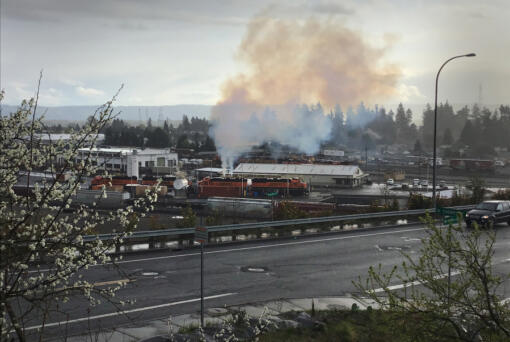
He brought a photo panorama to illustrate his theory that steam from the power generating plant on Lower River Road may have played a role in the January tornado.
“It could have helped start the rotation even more,” he said.
Timm, the columnist for The Columbian, said he was born in Portland and has watched the weather since he was a kid.
“When I was 12, I cut grass and washed cars and saved money to buy my first wind gauge,” he said after the meeting.
“Two weeks later came the Columbus Day Storm (in October 1962). After that storm, my wind gauge was gone. I told people it was probably blown all the way to Seattle.”
That gale took down enough trees to build 690,000 homes. Damage was especially heavy along the Chehalis River in Lewis County, according to Columbian files.
Timm’s weather observations and blogs are at weathersystems.com.
John Branton: 360-735-4513 or john.branton@columbian.com.