

Archives | Contact Us | Columbian Publishing Company | e-Edition | Mobile | Place an Ad | RSS | Subscribe

    Digg Stumble Upon  Reddit  twitter    del.icio.us

Local News

Rush to register to vote sweeps Clark County

Thursday, October 2 | 9:17 p.m.

KATHIE DURBIN, COLUMBIAN STAFF WRITER

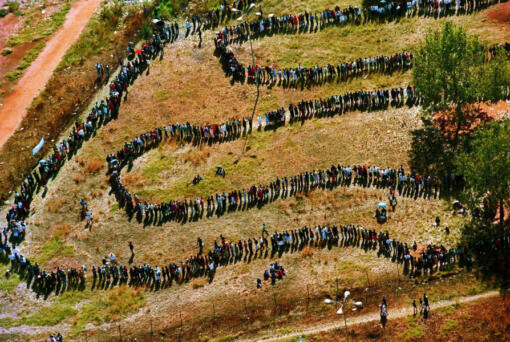
Curious how much excitement the November 4 election is generating? Here’s a hint: 4,058 new voters have registered in Clark County in just the past week.

Statewide, more than 35,000 new voters have registered since Sept. 24, most of them in King, Pierce, Clark, Snohomish, Spokane, Whatcom and Thurston counties. Percentage-wise, Clark leads the pack, with a 2 percent registration jump. As of Oct. 1, the county had 205,423 active registered voters.

With fiercely contested high-stakes presidential and gubernatorial races hanging in the balance, the interest in voting isn’t a surprise.

But Secretary of State Sam Reed, a Republican who is running for reelection himself, wants to push that number even higher. That’s why he visited Vancouver Thursday to remind voters that Saturday is the last day people can register to vote by mail or online.

After that, voters who are not registered in the state may register in person until Oct. 20 at the elections office, 1408 Franklin St. in downtown Vancouver.

“I think people are just beginning to realize that the election is coming up soon,” Reed said.

County Auditor Greg Kimsey takes some credit for the county’s growing voter rolls. With help from the county’s property database, his office mailed postcards to 58,000 households with no registered voter, urging qualified voters to register online.

On the University of Washington campus, according to the Seattle Post-Intelligencer, students are registering classmates via their iPhones and an online voter registration application called “Your Revolution,” which is implemented through the social networking site Facebook.

It works this way: a voter registers through the application and ultimately through the secretary of state’s Web site, then invites his or her entire Facebook network to register. An estimated 90 percent of college students have Facebook accounts.

Organizers in Washington and Arizona, the only states that allow online registration, claim they have registered more than 4,500 voters in the two states.

Reed and county election officials statewide dodged a bullet last week when a King County Superior Court ruled against the state Democratic Party in a lawsuit challenging Republican gubernatorial candidate Dino Rossi’s identification of his party preference on the ballot as “GOP Party.”

Democrats said polls indicated large numbers of voters did not know that GOP was a nickname for Republicans and accused him of trying to distance himself from his party. Rossi’s campaign dismissed the allegation.

If the ruling had gone the other way, “It would have been disastrous,” Reed said. Many counties already had sent their ballots to the printer, and the state might not have been able to meet a federal deadline for mailing ballots to members of the military stationed overseas, he said.

Reprinting the voters’ pamphlet alone would have cost up to $1.5 million, Reed said.

The 2009 Legislature will have some tweaking to do on the larger question of how candidates may identify their party preference under the top two primary system, Reed said.

Because political parties no longer nominate candidates, this year’s primary featured some creative party labels, including the Salmon Yoga party.

“I didn’t like the idea of people being able to make up party names,” he said. “The state hasn’t had to define party before.” New parties may have to meet some minimum membership threshold to prove they are legitimate, he said.

Mail ballots will go out Oct. 15 in Clark County, Kimsey said. That gives voters 20 days to return them.

Candidate debates and other campaign developments will continue right up until election day. But Reed said there’s an advantage to stretching out the voting over a couple of weeks instead of requiring all voters to cast their vote at a polling place on election day.

“By having it on one day, some incident can skew the election,” he said. “Another thing that is beneficial is that it has limited the last-minute hit piece where the candidate doesn’t have time to respond.”


Copyright 2009 columbian.com. All rights reserved. Use of this site constitutes acceptance of our user agreement.